

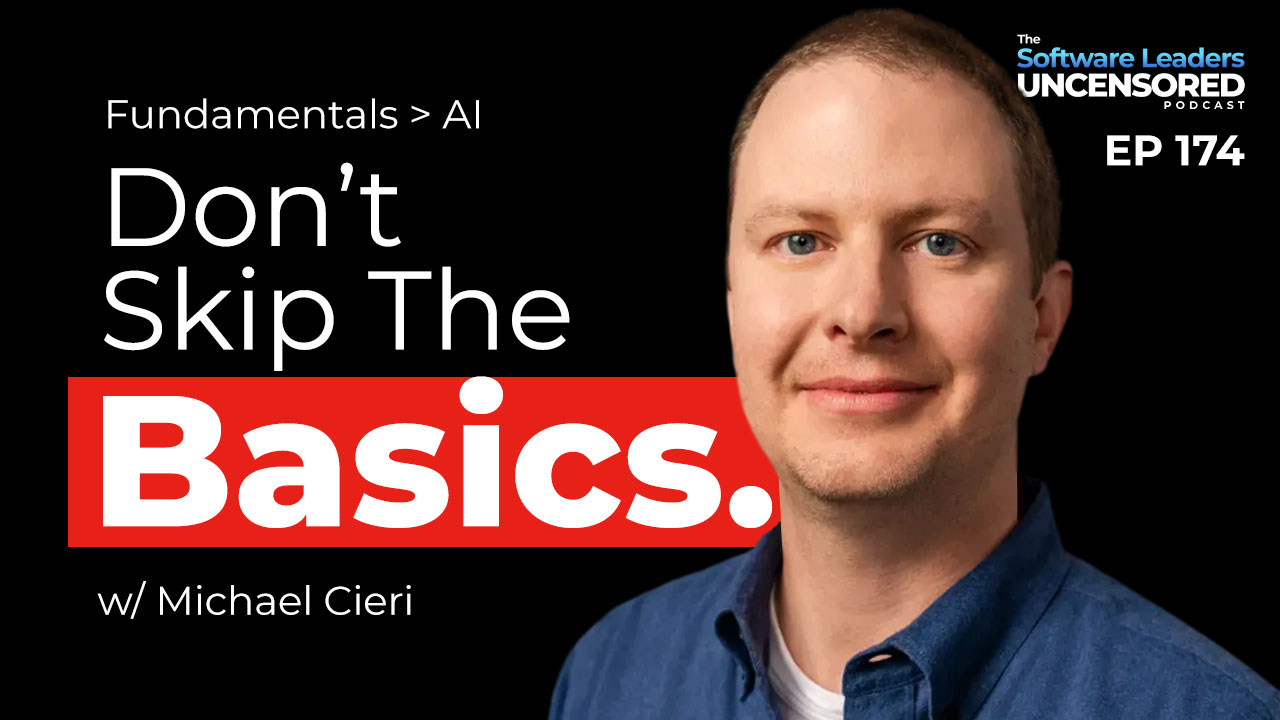

Michael Cieri (EVP of Software at BILL) explains how BILL is scaling AI across financial workflows by moving from decentralized experimentation to a centralized AI platform for consistent, multi-product outcomes. He shares lessons from Square on pricing changes and the need for sharp customer focus (including narrowing Square Appointments to independent hairstylists), and he explains why trust and risk management shape BILL’s phased approach, starting with workflow agents like a W-9 collection agent before moving toward higher-stakes, money-moving automation.
In this episode of Software Leaders Uncensored, host Steve Taplin (CEO of Sonatafy Technology and author of Fail Hard, Win Big) speaks with Michael Cieri, a product and business leader with over 20 years of experience. Steve introduces Michael as having worked at companies including Opendoor and Square, and Michael shares that he was most recently Chief Product Officer at Gusto before becoming EVP of Software at BILL.
What BILL does
Michael describes BILL as a financial management platform for SMBs. He says BILL helps small and midsize businesses run financial operations, gain insight into cash flow, manage spend, and manage money coming in, giving them a holistic view of their financial management to support better outcomes.
Michael says he joined BILL last May and describes his first months as moving past the “drinking from the fire hose” phase and into execution.
How Michael got the role
Michael explains that he has spent most of his career in engineering or product roles, and for the last ~15 years has focused primarily on building technology for small businesses. He says he spent about eight years at Square working on SMB software and that he has entrepreneurial roots (describing his grandfather owning a bowling alley where he spent time growing up).
He describes SMBs as historically underserved by technology and says Square stood out by bringing enterprise-like capabilities to SMBs with a consumer-style focus on simplicity.
When Steve asks how the opportunity came together, Michael says he followed BILL for a long time and monitored the company in the bill pay space while he worked on Square Invoices (which moved into bill pay). He says an important connection was an old colleague from Square, Mary Kay Bauman, who is his counterpart at BILL leading payments and financial services. Michael says she encouraged him to take a look, and he also points to the strength of BILL’s leadership team, including CEO René. He notes a recruiter was involved, but says senior roles often begin through network-based connections.
Cutting-edge work: applying AI to financial workflows
Michael says AI is a major focus at BILL. He explains that workflow-heavy products—like paying bills, sending invoices, and reconciliation—are fertile ground for AI because the time savings can be substantial. He describes two themes: saving time by accelerating workflows and improving outcomes by reducing mistakes, such as catching invoice errors (including accidental mistakes like an extra zero).
He also notes that BILL has used machine learning for a long time (particularly in accounts payable), and that in some cases LLMs can replace older ML approaches, while in other cases LLMs enable net-new use cases.
From experimentation to a centralized AI platform
Michael says many organizations have moved past early experimentation and are now figuring out how to deploy AI at scale. He describes BILL’s early stage as decentralized—teams using different models and tools for different use cases—followed by a push toward a centralized AI model built on a shared AI platform.
He describes the platform approach as enabling consistent data access for models, the ability to use multiple LLMs depending on the use case, and shared infrastructure so agentic solutions across products don’t produce inconsistent outcomes. He ties this to BILL’s goal of delivering consistent experiences across a multi-product platform.
Michael says this investment is accelerating the speed and consistency of AI innovation, with multiple releases expected in the second half of BILL’s fiscal year and the first half of the calendar year.
Discussion: Apple, LLM commoditization, and model strategy
Steve references a Wall Street Journal article about Apple saying it won’t build its own LLM for Siri and will instead make Siri interchangeable across multiple LLMs. Michael says it’s interesting and that he’s surprised a company at Apple’s scale wouldn’t want more ownership of an LLM, given how much AI can shape user experiences. He adds that for companies like BILL, not building an LLM and instead leveraging external models makes sense, but for top-tier tech giants, Apple’s approach feels unexpected.
Increasing velocity and productivity beyond R&D
Michael says productivity gains from AI are clearer in R&D-adjacent areas like prototyping, front-end work, engineering tooling, and synthesizing customer insights. He says it’s less clear outside R&D, and BILL is exploring how to drive AI productivity gains at scale across the broader organization.
He and Steve also discuss the challenge of constantly chasing the next tool. Michael says this raises the importance of judgment: evaluating AI outputs, trying alternative approaches, and applying human decision-making on top of model suggestions.
Serving SMBs: huge market, massive variation
Michael explains that SMBs are a large market by count and spend, but vary widely by size, vertical, and geography, making it hard to build solutions that aren’t too niche. He says BILL focuses on the financial management layer of the SMB “stack,” and that financial operations often have more shared jobs-to-be-done across businesses than other categories. He says BILL aims to be excellent at those common needs while selectively building more tailored solutions when necessary.
Two hard-earned lessons from Square
Be careful tying pricing changes to feature launches. Michael describes a situation with Square Invoices where new functionality was needed by an important segment, but a pricing increase launched alongside it. Customers who didn’t need the new functionality reacted strongly. He notes SMBs are often highly price-sensitive and says it was a tough lesson in how pricing changes are framed.
Get extremely clear on the target customer when a product struggles. Michael recounts Square Appointments, saying the launch was mediocre because the team wasn’t clear on who it was solving for. He says the turnaround came when the team narrowed focus to independent hairstylists renting a chair. He describes interviewing around 150 of them, getting the product right for that group first, then expanding. He says the product was nearly killed but later scaled significantly.
2026 focus and the trust hurdle
Michael says BILL’s key focus is automating finance and helping SMBs realize AI’s impact on financial management. He describes a staged approach: workflow agents that save time first, and higher-stakes capabilities later.
He gives an example of a W-9 agent that helps gather W-9 information needed for 1099 filing, reducing back-and-forth emails while avoiding money movement.
Michael agrees that trust is a major factor for SMB adoption, especially for sensitive financial activity, and says BILL’s long-standing brand and track record provide an advantage.
Closing advice: don’t lose the fundamentals
Michael’s advice is that the fundamentals of strong product development do not change even with AI accelerants: deep customer understanding, high-judgment people who can navigate ambiguity, and a driven team that believes in what it’s building. He warns against losing sight of fundamentals and assuming “AI knows what the customer wants.”


