

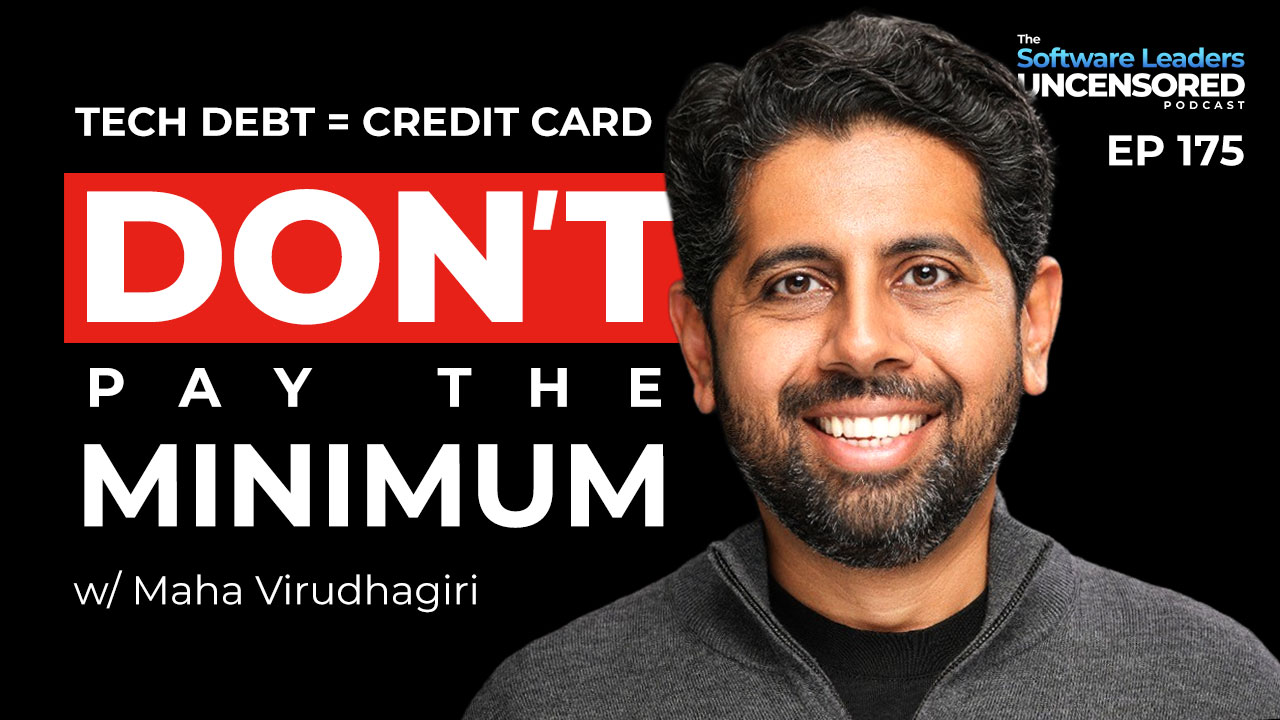

Coalition CTO Maha Virudhagiri explains how Coalition combines cyber insurance and cybersecurity, why he joined after seven years at Tesla, and what he changed to increase speed: tackling tech debt, reducing overplanning, and adjusting org design. He shares how Coalition rolled out AI tools beyond engineering with Gemini and Glean, describes a high-agency culture that demands overcommunication, and argues that the biggest enemy of scaling teams is complexity.
Maha Virudhagiri on Coalition, cyber insurance, and building high-agency teams at scale
In this episode of Software Leaders Uncensored, host Steve Taplin speaks with Maha Virudhagiri, the CTO of Coalition, which Maha describes as both a cyber insurer and a cybersecurity provider. Maha says Coalition’s mission is to “protect the unprotected” by combining insurance and cybersecurity to help businesses reduce risk and stay protected, especially those that may not have the resources to defend themselves day to day.
Steve notes Coalition is well funded and not small, and Maha shares that Coalition raised a Series F in July 2022, valuing the company at $5 billion. Maha also says he joined Coalition about 10 months prior to this conversation and describes the pace and momentum since joining as energizing.
How Maha became CTO of Coalition
Maha explains he spent about seven years at Tesla, then took a break with the intent of spending time with family, including around the time his daughter was leaving for college. During that break, a recruiter reached out about Coalition.
Maha says his initial reaction was skepticism, describing cyber insurance as something that “smelled like snake oil” because he had not heard of it before. He says he read up on the cyber insurance market, looked into Coalition, and spoke with Josh, Coalition’s CEO and founder. Maha describes Josh as a strong storyteller and technologist and says Josh was transparent early, offering “the good, bad, and ugly” and leaving the decision to Maha. Maha says he had 15 to 20 conversations across the leadership team and board over a couple of months and appreciated the process as a partnership fit check in both directions.
What slows teams down
When asked what slows engineering and product teams down, Maha cites what he calls an “unholy trinity”: tech debt, overplanning, and org design. He says the org made changes to structure and planning to improve urgency and execution speed. One major process shift was moving from quarterly planning to monthly planning, while still keeping a longer-term “North Star.” Maha says quarterly plans became outdated quickly and monthly planning creates faster iteration and flexibility when business conditions change, though it can also introduce planning fatigue.
Productivity workflows and AI tooling
Maha says Coalition’s approach to AI was organized into several buckets and that engineering went “all in” on tools including Cursor and some Copilot, with some engineers using Open Code as well. He compares these tools to giving engineers an “exoskeleton,” using an analogy of turning Tony Stark into Iron Man.
Outside engineering, Maha says Coalition rolled out Google Gemini and Glean, with the intent to “supercharge every Coalition employee.” He says internal information discovery should be fast, and the feedback from employees has been positive.
On Glean specifically, Maha says a pilot was up in about a week, leadership did a hands-on session during an executive offsite, moving from pilot to licensing took about 30 days, the company did a soft launch before the holidays, and agent creation was temporarily disabled before the holidays to avoid “rogue agents” causing problems during that period. He also says the company is implementing training, rollout, and governance around what agents are built, what connectors they use, and what they can access.
Maha also says Coalition does not want to be locked into one tool forever and expects to reassess tools as the market changes, while avoiding “shiny object syndrome.”
Using Glean to reduce meeting load and speed learning
Maha says Glean connects to systems like GitHub, Jira, Confluence, Slack, and emails, helping synthesize information. He says this has helped reduce meetings and repetitive writing because the information already exists in company systems. He also shares that commercial insurance is complex and that Glean helped him ramp into a domain that felt humbling even after his prior experience implementing Tesla insurance end to end.
Leadership philosophy and simplifying systems
Maha describes a leadership framework he calls Occam’s razor, emphasizing that the simplest solution is most likely correct and that many frameworks can be ways to avoid hard decisions. He says prioritization changes depending on business realities and that leaders should be willing to change course if something is not working.
He also says it is harder to implement simplistic solutions than complicated ones, and that Coalition tries to remove unnecessary complexity. Maha describes an approach of continually deleting things, including code, meetings, processes, and feature flags, to prevent complexity from piling up over time.
Tech debt as a credit card
On tech debt, Maha says some tech debt can be healthy, comparing it to financial debt. He uses a credit card analogy: using debt can buy speed, but if you only pay the minimum balance indefinitely, it will eventually catch up and cause serious problems. He says teams sometimes have to slow down to move fast, and that it helps to explain the trade-off to business stakeholders in financial terms.
Remote-first operations and onboarding
Maha says Coalition is remote-first and engineers are distributed across locations including San Francisco, London, France, Portugal, Toronto, and more. He notes this is his first remote role, and describes a personal learning curve because he prefers in-person energy and hallway context.
He says Coalition’s onboarding includes early sessions where department leads share how their teams work. He also mentions recurring company forums and in-person gatherings, including a recent in-person meeting with the sales team in San Diego, and says bringing people together multiple times per year helps build trust and speed later decisions.
On engineering onboarding, Maha says he set a target that every new engineer should push code to production in the first week, acknowledging it is aggressive but viewing it as a helpful bar for momentum and fit. He says the longer a new engineer goes without shipping, the more corporate they can become, and shipping is a strong signal of onboarding health.
High-agency culture, metrics, and alignment
Maha describes Coalition’s effort to move away from a permission-based culture toward high agency, and references a phrase used internally: “You can just do things.” He says high agency requires overcommunication so decisions do not create fire drills for others, especially in remote and multi-time-zone contexts. He also notes the company still has safeguards like code reviews, SLOs, monitoring, and observability to prevent accidental outages.
Maha says the company discussed metrics such as DORA metrics, but he views many common measurements as vanity metrics. He says Coalition is moving toward what he calls “sanity metrics,” focusing on mean time to value: how long it takes for an idea to become a feature that users can actually use, whether the user is internal or external. He mentions measuring this with a mix of quantitative signals and qualitative feedback on whether outcomes truly add value.
On alignment, Maha says meetings can become a major productivity drain and that many meetings could be replaced by Slack messages and async updates. He says teams are encouraged to leave meetings when they are not learning or contributing value. He also says the company tries to push more operating updates into async formats and prefers meetings that focus on design, architecture, and problem-solving rather than prolonged debates about what to build.
The common mistake he tries to avoid and closing advice
Maha says complexity is the “devil” and that organizations naturally add layers of process, people, and meetings as they grow. He says Coalition is trying to stay process-light and keep teams flatter to speed decision-making. He also says the company aims to rethink processes before automating them, arguing that automating bad processes can simply harden complexity.
For his closing advice, Maha says leaders should hire hungry people, give them high agency and the best available tools, then get out of their way. He says if a leader has to micromanage, either the wrong people were hired or the leader has become the bottleneck. He also distinguishes micromanaging from being detail-oriented, describing detail focus as a sign that leaders care.


