Your Engineering Team Is Not the Problem. Your Delivery Model Is.
Diagnostic clarity and accountable delivery, from US principal engineering leadership and senior LATAM engineering teams operating in your time zone.
Every quarter your delivery model stays broken, the coordination tax compounds. The cost is not linear. It is exponential.








195+ Conversations with Leaders From
The Problem
More Engineers.
More Meetings. Less Shipping.
Your engineers are not the problem. The delivery model breaks as complexity grows. The roadmap expands. Headcount increases. Everyone stays busy. Nobody owns the outcome.
Organizations that ignore this do not plateau. They regress.
The Coordination Tax
The Hidden Cost of Scaling Without Ownership
Lost annually by a 30-person engineering team. Not from bad engineers, from a delivery model where nobody owns the outcome.
"Double the team, and the coordination tax doesn't double, it compounds."
"We went from six-week release cycles to shipping every two weeks. In 90 days, the backlog stopped growing and we actually started clearing it."
VP of Engineering, Series C Healthtech Platform
Why Software Projects Fail
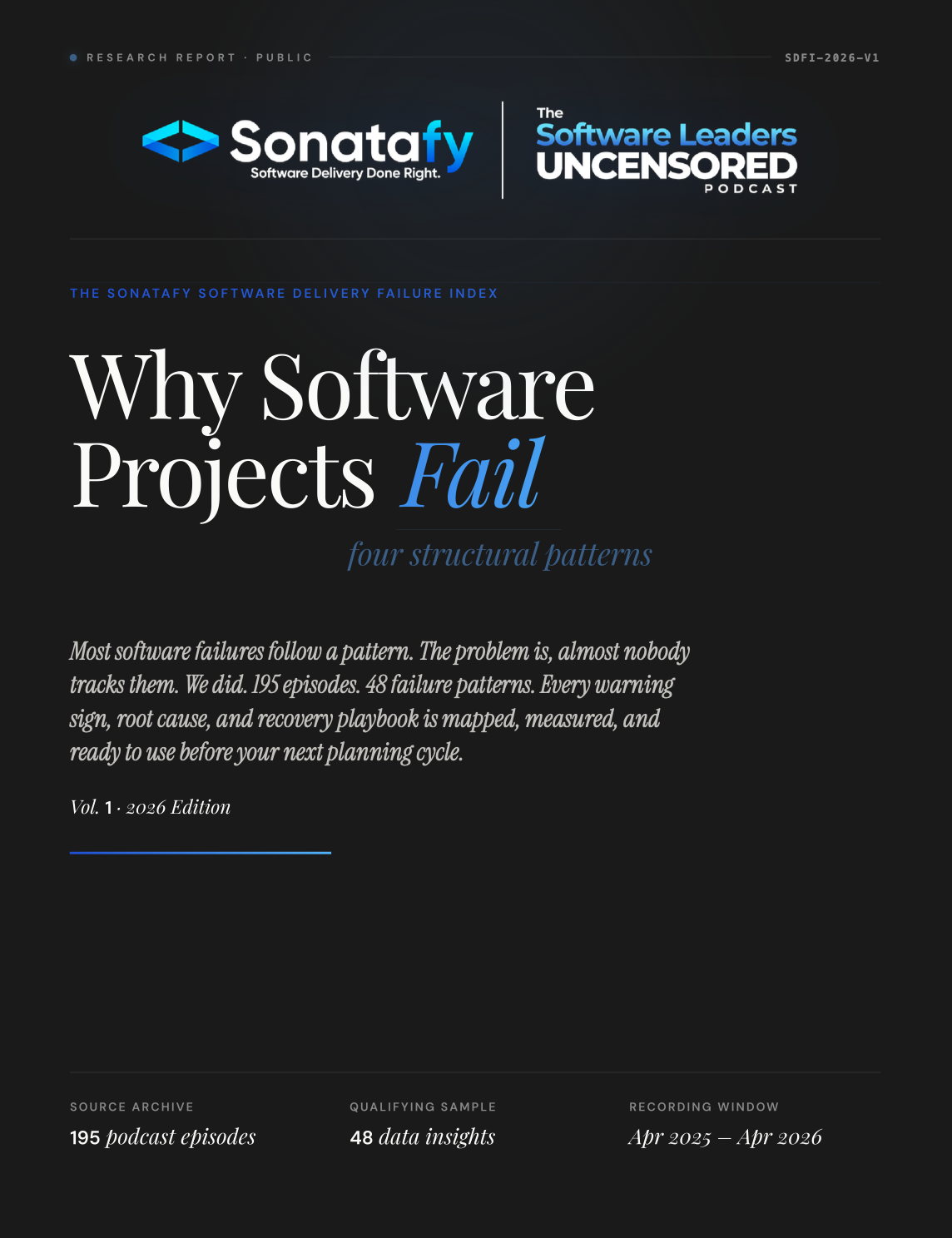
Most software failures follow a pattern. Almost nobody tracks them. We did. 195 episodes. 48 failure patterns. Every warning sign, root cause, and recovery playbook — mapped and measured.
What Inaction Costs You
Every Quarter You Wait, the Gap Widens.
If your last quarter missed roadmap commitments and your team is already planning to miss again, these are the patterns that explain why.
Missed Roadmap Commitments
Engineering reports green. Product reports progress. But shipped features consistently miss the quarter. Leadership loses confidence in timelines, and board conversations shift from growth to explanation.
Rising Cost Per Feature
Each new hire adds coordination overhead without proportional output. Your cost per shipped feature climbs while velocity flatlines. The budget grows. The backlog grows faster.
Talent Attrition
Senior engineers leave organizations where they spend more time in meetings than writing code. The engineers who stay inherit more context switching, more dependencies, and less ownership.
These patterns compound. They do not resolve with more headcount. They resolve with a different delivery model. And the longer you wait, the more expensive the fix becomes.
The Core Problem
The Ownership Gap Is Killing Your Delivery
Your teams are not underperforming. Nobody owns the outcome. That is a structural problem, not a talent problem.
The Four Frameworks
Four Frameworks for Where Software Delivery Breaks Down
Each framework names a specific failure pattern. The diagnostic principle below points to which one is in play in any given situation.
Who owns the outcome
Ownership Gap
Responsibility fragments across product, engineering, DevOps, and vendors. Everyone contributes but nobody is accountable for the outcome from roadmap to production.
- ✕Product, engineering, and DevOps each own a slice, no one owns the result
- ✕Roadmap commitments slip with no clear escalation path
- ✕Leadership cannot point to a single accountable owner per initiative
What is the cost of every new hire
Coordination Tax
Adding engineers without fixing structure adds 15 to 25% coordination overhead and only 5 to 10% real output. Communication paths grow faster than throughput.
- ✕Standups, syncs, and handoffs consume more time than building
- ✕Each new hire slows the team for the first quarter, sometimes longer
- ✕Output per engineer trends down as headcount goes up
Why does the backlog keep growing
Backlog Illusion
A full backlog looks like progress but is a symptom of structural delivery failure. More tickets do not mean more shipped software when ownership is fragmented.
- ✕Backlog grows faster than the team can execute against it
- ✕Tickets get reprioritized weekly without ever reaching production
- ✕Velocity charts look healthy while the roadmap quietly slips
Did the work actually deliver the outcome
AI Validation Gap
AI initiatives ship without a defined standard for working, without evaluation frameworks tied to business outcomes, and without production telemetry that can detect degradation. Teams discover problems when users or regulators do.
- ✕No evals before launch, success defined as "we shipped the model" rather than "it produces correct outputs"
- ✕Hallucinations and bias issues escaping to production
- ✕Boards asking "is the AI initiative working" with no data to answer
The Diagnostic Principle
One Question at a Time, Until the Real Failure Surfaces
When a real client situation could fit two frameworks, identify the root cause, not the symptom. This sequence applies to discovery calls, RFP responses, and report scoring. It is the diagnostic methodology Sonatafy uses across 60+ client engagements.
Is there a single accountable owner for end to end delivery?
Do teams coordinate cleanly across handoffs and vendors?
Can the team measure whether the output is correct?
The Scaling Trap
Why Hiring More Engineers Makes This Worse
The instinct when delivery slows is to add headcount. More engineers should mean more output. But in a fragmented delivery model, each new hire adds more coordination overhead than productive capacity. The math works against you.
15–25%
Coordination overhead added per new hire
5–10%
Actual output increase per new hire
$270K
Fully loaded cost per engineer annually
A 30-person engineering team operating without clear delivery ownership loses $900K to $1.5M annually. Not from bad engineers, but from a model where adding people increases communication paths faster than it increases throughput. The fix is not more people. It is a delivery model where someone owns the outcome.
How We Solve It
Your Team Gets
Delivery Ownership
Senior talent. Architecture-first discipline. A clear owner responsible for outcomes, not activity.
Fix Delivery Speed
Eliminate the structural drag that slows every release.
Scale Without Chaos
Add capacity that comes with built-in ownership.
Ship the Roadmap
Turn quarterly promises into production software.
For executives, not just engineering leaders
Most of this site is built for engineering leaders who need to ship. If you are a CEO, founder, or operating partner trying to find what is capping growth, or preparing for a transaction, we have two practices built for your altitude.
Diligence Readiness
Prove your Product, Engineering, and AI will pass transaction scrutiny.
Explore diligence readinessWhy Sonatafy Is Different
Most Vendors Supply Talent. You Get Accountability.
See how Sonatafy compares to staffing firms, offshore vendors, consulting shops, and internal hiring.
What We Do Not Do
Clear Boundaries Build Trust.
AI Embedded Across the Lifecycle
28 AI Use Cases. 7 SDLC Phases. One Owner.
Every Sonatafy engagement embeds AI into how we work, from ideation and sprint planning to testing and deployment. Not as an experiment. As a delivery standard.
AI-assisted sprint planning and code review have reduced defect escape rates and shortened cycle times across active POD engagements.
Built by Operators, Not Theorists
The People Behind the Model Have Lived the Chaos
Every framework, process, and delivery pattern at Sonatafy comes from decades of building, failing, and shipping real software.
Proven Delivery Track Record
Over 60 engagements across healthcare, enterprise, fintech, AI, manufacturing, and SaaS, each with documented outcomes and measurable impact.
See Results →Software Leaders Uncensored
Raw conversations with CIOs, CTOs, and engineering leaders on what actually works in software delivery. Over 195 episodes and counting.
Watch on YouTube →Forbes & Entrepreneur Articles
Published insights on software delivery, AI strategy, and scaling technology organizations. Featured in Forbes Technology Council and Entrepreneur.
Read Articles →Fail Hard Win Big
Steve Taplin built 30+ companies. Twenty failed. Ten succeeded. The lessons and patterns are all in the book.
Get the Book →"Sonatafy Technology employees feel like HG employees."
Michael Nickerson, CTO of HighGround, on Sonatafy serving as their software engineering organization from inception through multiple funding rounds.
Industries We Serve
Built for Organizations Where Delivery Cannot Slip
Sonatafy partners with US based companies that prioritize delivery accountability over simply adding headcount.
Intelligence Hub
Latest from the Intelligence Hub
Forbes Article
The Hidden Cost of a Growing Backlog
Why your backlog is not a to-do list, it is a symptom of structural delivery failure.
Podcast
Software Leaders Uncensored
195+ unfiltered conversations with CIOs, CTOs, and engineering leaders on what actually works.
Book
Fail Hard, Win Big
30+ companies. 20 failures. 10 successes. The lessons that built the Sonatafy delivery model.
Engineering Assessment
How Mature Is Your Engineering Delivery?
Take our Engineering Velocity & Leverage Maturity Assessment to uncover bottlenecks, measure execution health, and benchmark your team.
Product Assessment
Is Your Product Team Operating at Full Capacity?
Take our Product Team & Processes Maturity Assessment to evaluate your product organization's effectiveness and identify growth opportunities.
Five additional diagnostic assessments are available, covering QA, Production, Mobile, Backlog, and Platform and SDLC. .
Benchmark your readiness
Two diagnostics matched to this page.
Free · confidential · no sales call
Delivery Maturity Assessment
Benchmark your team's velocity, coordination, and execution health against high-performing engineering organizations.
Leadership Readiness Assessment
Pinpoint where your engineering leadership and org design need to evolve to support the next stage of growth.