

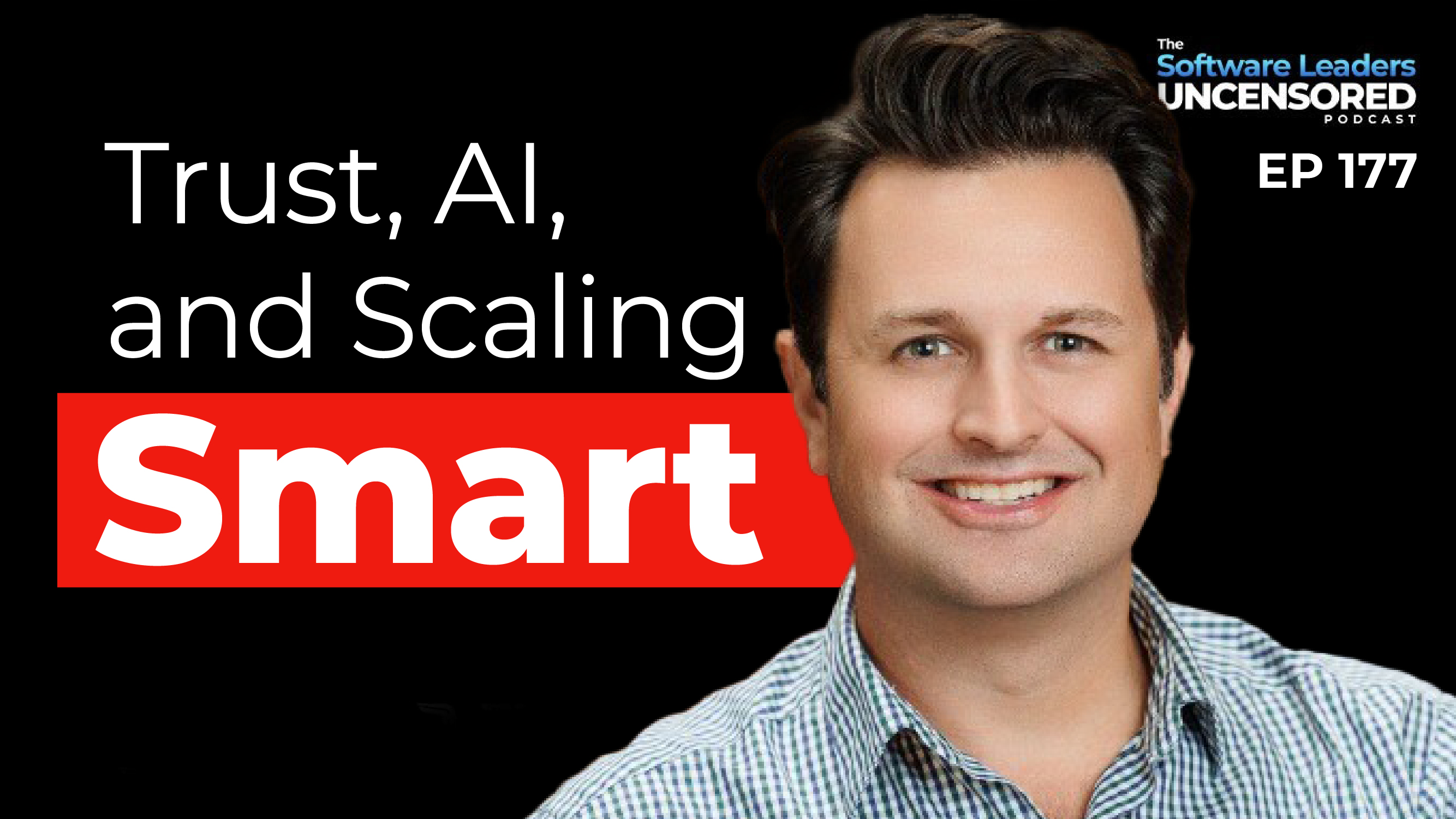

Graphika’s CEO Guyte McCord explains how AI is letting the company scale network intelligence by shifting from dashboard-heavy SaaS tooling to an AI “world model” plus agentic workflows. He talks about remote-first collaboration challenges, knowing when to pause and pay down tech debt, and why leaders must stay disciplined against investor-driven drift and costly AI hype. His closing advice: AI boosts execution, but deep problem understanding still wins.
Graphika’s CEO on scaling network intelligence with AI, remote collaboration, and staying grounded in the problem
Graphika sits in a high-stakes corner of the tech world: turning online conversation data into intelligence that organizations can act on. In this episode of Software Leaders Uncensored, Steve Taplin speaks with Guyte McCord, CEO of Graphika, about the company’s evolution, how AI is reshaping their platform strategy, and the leadership realities of running a deeply technical business without being an engineer.
What Graphika does and where it shows up
Graphika provides intelligence data across both enterprise and public sector customers. Their work spans national security, defense, financial services, strategic communications, and digital marketing. One area where they’re especially recognized is supporting efforts to detect and respond to networks of inauthentic accounts, including those tied to foreign adversarial governments. In many of those cases, Graphika is “in the background,” supplying the intelligence and data used for detection and analysis.
They also support a broader set of use cases using the same core technology across public and private sector customers.
A leadership path from CRO to COO to CEO
McCord has been at Graphika for more than seven and a half years, initially joining from the commercial side of enterprise technology. His career started in enterprise sales, with additional experience in project management and client services, but the bulk of his background is front-facing, revenue-driven work.
At Graphika, he began by owning revenue responsibilities across sales and marketing. From the start, he had discussions with the company’s founder—described as a highly technical founder—about a transition where the founder would shift into an executive chairman role to focus fully on advanced technology development. McCord’s progression from CRO to COO to CEO followed that transition over several years.
McCord notes the transition from CRO to COO was actually the bigger leap. He didn’t fully drop CRO responsibilities when he took on COO duties, which raised the difficulty level. The shift required a mindset change: moving from pushing for investment and spend to grow revenue, to also being responsible for cost, margins, and financial controls.
Reframing the platform strategy around AI
Graphika’s platform focus is heavily shaped by AI—something McCord describes as a major scalability and productization unlock for their business.
Historically, Graphika built a unique core capability: creating large-scale models—“maps”—of the information environment. That core technology is powerful and distinctive, but translating it into self-serve software dashboards and typical SaaS analytics experiences has been hard.
AI has changed the path forward. Graphika is repositioning its north star away from building dashboard-heavy analytic tooling and toward building what McCord calls an AI “world model” for the information environment, paired with agentic AI that can query that model and produce decision-ready reporting. The goal is to bypass the adoption challenges of dashboards and widgets and instead deliver outcomes through AI-driven interpretation and synthesis.
Remote-first realities: the easy work stays easy, the new work gets harder
Graphika went remote during the pandemic and has since returned gradually to the office—but remains remote-first, with office locations in New York and Washington, DC.
McCord describes the trade-off clearly: work that teams already know how to do tends to translate well to remote. But building something new—especially when trying to move fast—gets harder in a remote environment. He notes the overall product and engineering cycle is accelerating dramatically in the new AI landscape, which increases the collaboration challenge.
Technical debt: normal, but expensive when ignored
Graphika is working through a technical debt moment that many scaling companies recognize: complex core technology, plus complex supporting systems that have accumulated over time.
McCord describes a current push to modularize and modernize parts of their underlying systems. It requires pausing forward momentum for a couple of months to complete a major systems upgrade. He’s realistic about the trade-off: it’s painful, but the company expects to be better on the other side.
He also shares a leadership lesson: the hard part is knowing when to hit the brakes. In his experience, once you begin to feel that a debt issue needs attention, waiting rarely helps.
Leading a technical company without being an engineer
McCord says there’s no substitute for direct engagement. In remote-first settings especially, engineering and product teams can experience thrash when they perceive decisions coming “from above” driven by commercial pressure. Without ongoing explanation of the customer reality and strategic rationale behind priorities, fatigue builds and trust erodes.
His approach is consistent communication—less “fancy all-hands presentation,” more frequent, smaller conversations that fill in the gaps and build shared understanding.
The true scaling blocker: human expertise
Graphika’s biggest historical scaling constraint wasn’t purely software—it was the need for human subject matter experts to interpret complex data into customer-ready value.
McCord says Graphika built what he considers a world-class open source intelligence team using rigorous investigative methods. But as customer demand grows, that model hits a ceiling: you need more experts to serve more customers.
AI is now shifting that constraint. Instead of having analysts interpret the data once and deliver it as a one-off output, Graphika is moving toward persistent, AI-enabled analytic workflows. In this model, expert analysts guide the AI, quality-check it, and help create repeatable workflows that can be applied across many organizations.
Two common mistakes: investor-driven drift and AI hype costs
Investor-driven drift: In a venture-backed environment, companies must serve both customers and investors. Investors often have strong views on which customers to pursue and what to sell. McCord has seen companies follow that advice even when it doesn’t match their core strengths, sometimes leading to painful outcomes.
AI hype costs: AI hype increases the risk of runaway costs—especially cloud and data costs that can permanently damage gross margins. He argues it’s essential to have someone in the room willing to scrutinize shiny new tools and datasets and ask, “Do we really need this?”
A lightweight GTD system for execution
McCord shares a personal execution system inspired by David Allen’s Getting Things Done. He adopted a simplified version because the full method felt too complex to run consistently.
With too many daily actions, he drew on an approach he attributes to Mark Andreessen: identify the three most important priorities each day and commit to completing those first. The larger point is consistency: any framework only matters if you can apply it relentlessly.
No-BS advice: AI can’t replace deep problem understanding
McCord’s closing advice is a strong reality check for an AI-saturated era. AI can supercharge engineering, design, analytics, and more—but it still doesn’t replace the ability to deeply understand a new problem space. His recommendation: get truly deep on the problems, then use the technology to solve them.


